Grid Reaction
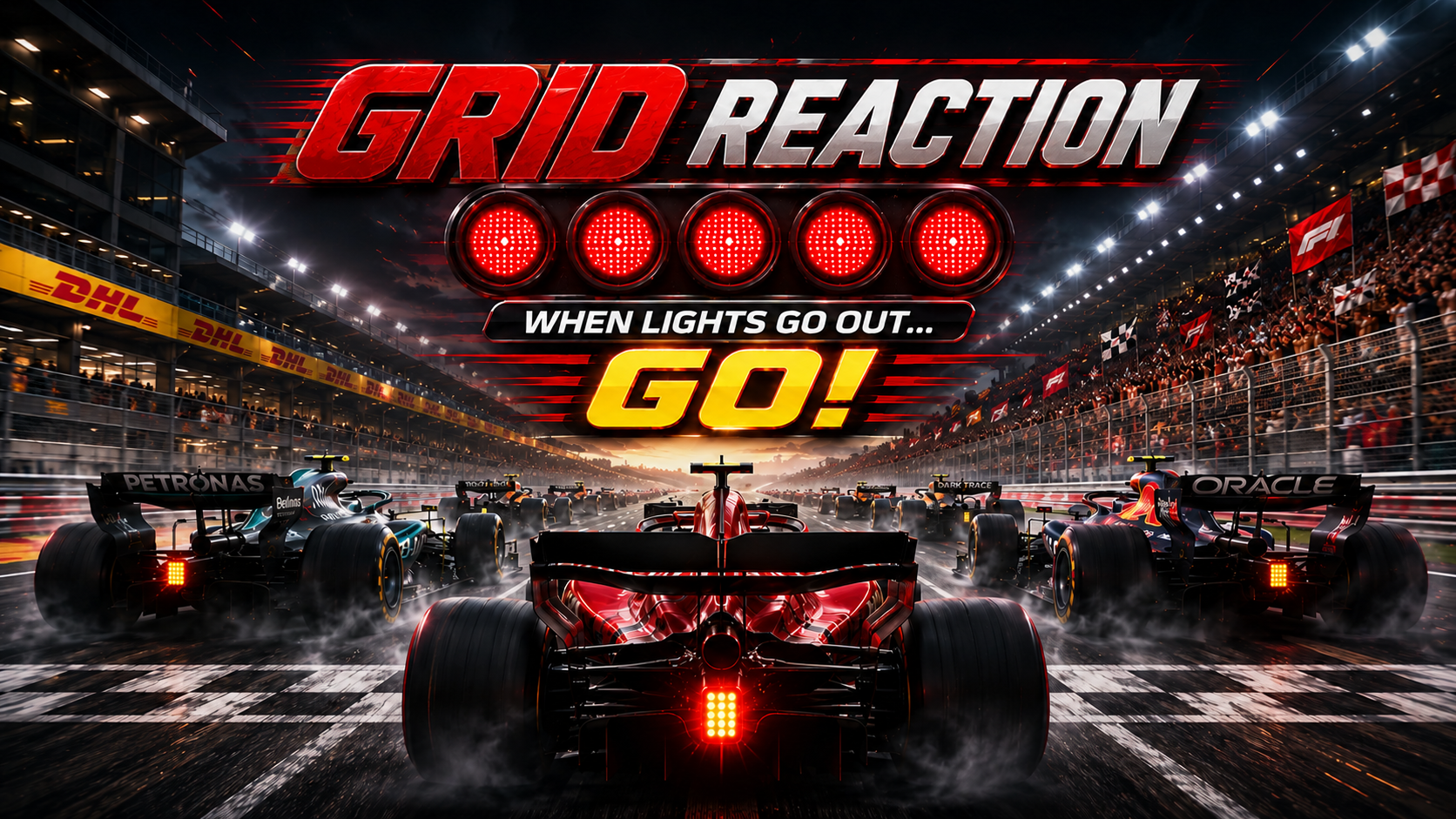
Five red lights, one by one. Then they go out — tap as fast as you can. Three attempts, total scored. Anticipate the lights and earn a drive-through penalty.
Subscriber Only: included with DreamPlay.Africa membership, ad-free.
How It Works
five red gantry lights, lights out, and the race is on — how fast can you tap?
Objective
Recreate the moment of a Race Day start across three attempts. Watch the five red gantries illuminate one per second, then react the instant they all extinguish. Tap fast and you score big — tap early and you get a drive-through.
Controls
On your phone
Tap the Start button to arm an attempt, then Tap anywhere on the track the instant the lights go out.
On desktop
Click the track, press SPACE, or hit Enter — all three register as your reaction tap.
How you're scored
Per attempt: score = max(0, 5000 − reaction_ms × 10). Your final result is the sum of all three attempts.
Tips
Scoring
Race Day Reaction Time is a pure-speed test. Three attempts; each one is timed in milliseconds and scored independently; total is the sum.
How the score is calculated
Each attempt ends with either a valid reaction time (in ms) or a fault. Valid attempts score by speed:
attempt_score = max(0, 5000 − reaction_ms × 10)
Faults (anticipated start, jump start, or no tap within 1.5 sec) score 0 for that attempt. The final score is the sum of all three.
Worked examples
What ends the round
The round ends after the third attempt is recorded. There’s no way to skip or re-run an attempt within a play.
Trivia
Where your tap fits in the racing world — and the FIA light system behind every start.
Reaction-time ranges
| Time | Rating | Description |
|---|---|---|
| < 150 ms | Elite | Rare; only the very top F1 starts hit this. |
| 150 – 200 ms | Very fast | Strong F1 driver range. |
| 200 – 250 ms | Good | Above average; trainable. |
| 250 – 300 ms | Average | Typical adult visual reaction. |
| > 300 ms | Slower | Plenty of room to improve with practice. |
The full FIA light system
Look closely at a real F1 grid gantry and you'll see four lights stacked vertically, not just the two reds that count down:
- Top — orange. Caution and rain-flag signals. Never lit during a normal start.
- Second — green. Lit before the start of the formation lap to send cars away on their warm-up.
- Bottom two — red. The actual countdown lights. One pair (one gantry) per second over the five-second sequence.
1. Fifteen seconds before the formation lap. The green start lights illuminate across all five gantries. Cars are ready to leave the grid for a warm-up lap to get tyres and brakes up to temperature. The greens extinguish at the moment the formation lap actually begins.
2. Race countdown. Once all cars are back on the grid, the bottom-two red lights illuminate one gantry at a time, every second, for five seconds. By the end of the countdown all ten red lights are blazing (this is the state your game shows you in its final second).
3. Lights out. After a random 0.2 – 3.0 second hold, all ten red lights extinguish in the same instant. That's the moment the race begins — and the moment your timer in this game starts ticking.
The pit-exit signal
The smaller gantry off to the right of the main five is the pit-exit light — three bulbs that tell drivers leaving the pit lane whether it's safe to join the track.
The longer countdown
The 5-second sequence this game simulates is the climax of a procedure that actually begins 30 minutes before the race. Every interval has a horn signal alongside the light changes:
- −30 min: pit lane opens (pit-exit red → green). No start lights.
- −17 min: horn — two-minute warning before the pit lane closes.
- −15 min: all five red start lights illuminate, pit exit closes (green → red), horn.
- −10 min: red start lights flash twice, horn.
- −5 / −3 / −1 min: one pair of red lights is extinguished at each interval, horn each time.
- −15 sec: last pair of reds extinguished — the green start lights illuminate. Cars ready to roll.
- Formation lap starts: all green start lights extinguished. Cars away for the warm-up lap.
- All cars back on grid: the visible 5-second countdown begins — this is the part you play.
What the orange lights mean
The top (orange) bulb on each gantry isn't decoration — it signals start delays and aborts. If anything goes wrong (a car stalls on the grid, debris on track, sudden weather change), the orange start lights flash. Two distinct cases:
- Before the 5-second signal: orange lights flash until the restart time is confirmed. When confirmed, the reds re-illuminate and the horn fires in two-second bursts for ten seconds, then the procedure resumes from the formation-lap step.
- After the 5-second signal but before lights-out: the orange lights flash and the red countdown lights freeze in their current state — meaning whatever stage the countdown had reached when the abort fired, that stays lit. When the restart is confirmed, all start lights extinguish and the procedure resumes (normally with a five-minute delay).
Race abort signals
If the race has to be stopped after it's started (red-flag for a serious incident), the lights tell every car what's happening:
- Race stopped: red start lights illuminate and flash twice. Orange start lights flash. Red pit-exit lights illuminate, horn fires — pit lane is closed.
- Ten minutes after the abort: red start lights re-illuminate, orange continues flashing, the pit exit turns green. If the stoppage will last longer than 20 minutes, the reds don't flash at this mark — the longer pause is implied.
- Restart confirmed: two pairs of red lights extinguish, horn, and the normal start procedure resumes — counting down to a new formation lap three minutes out.
Why 100 ms is the threshold
Reaction-time researchers consistently find that any response under about 0.12 seconds after a visual stimulus is anticipated — you started moving before you could possibly have processed what you saw. The 0.1-second floor used by F1 (and many other motorsports) sits comfortably below that scientific bound, leaving no room for any neurological argument that a sub-100 ms reaction was a genuine response. If you're under 100 ms, you guessed the timing. The stewards know it. The cars know it. Drive-through.
How to train it
Real F1 drivers train reaction time with light-board drills, batting cages and goalkeeper-style reflex apps. Sleep, caffeine, hydration and arousal level all swing your reaction time by 30 – 60 ms either way. Pay attention to how your scores drift across a few rounds — you'll see your own pattern.
Loading…
No reviews yet — be the first to rate this game.